
A friend just asked me what I though of USD.ai and the ticker $CHIP. You can see the X post here. $CHIP token, USDai, and sUSDai — This isn’t financial advice, just an attempt to unpack what the ticker, stablecoin, and interest yield is based on.
Last week, the USD.AI protocol publicly launched a set of core products and its governance token, $CHIP. If you saw the announcement but weren’t sure what it means — here’s a straightforward breakdown.

(Source: official USD.AI launch announcement)(X (formerly Twitter))
🧱 1. What Is USD.AI Aiming To Do?
USD.AI is a decentralized finance (DeFi) protocol seeking to unlock capital for AI infrastructure financing — particularly expensive computing hardware like GPUs — by using crypto liquidity in a structured way.(CoinDesk)
This isn’t about speculative tokens. It’s trying to marry stable, dollar-like assets with productive lending to real compute infrastructure (an area that historically has had trouble accessing traditional capital markets).
💵 2. The Two Tokens: USDai and sUSDai
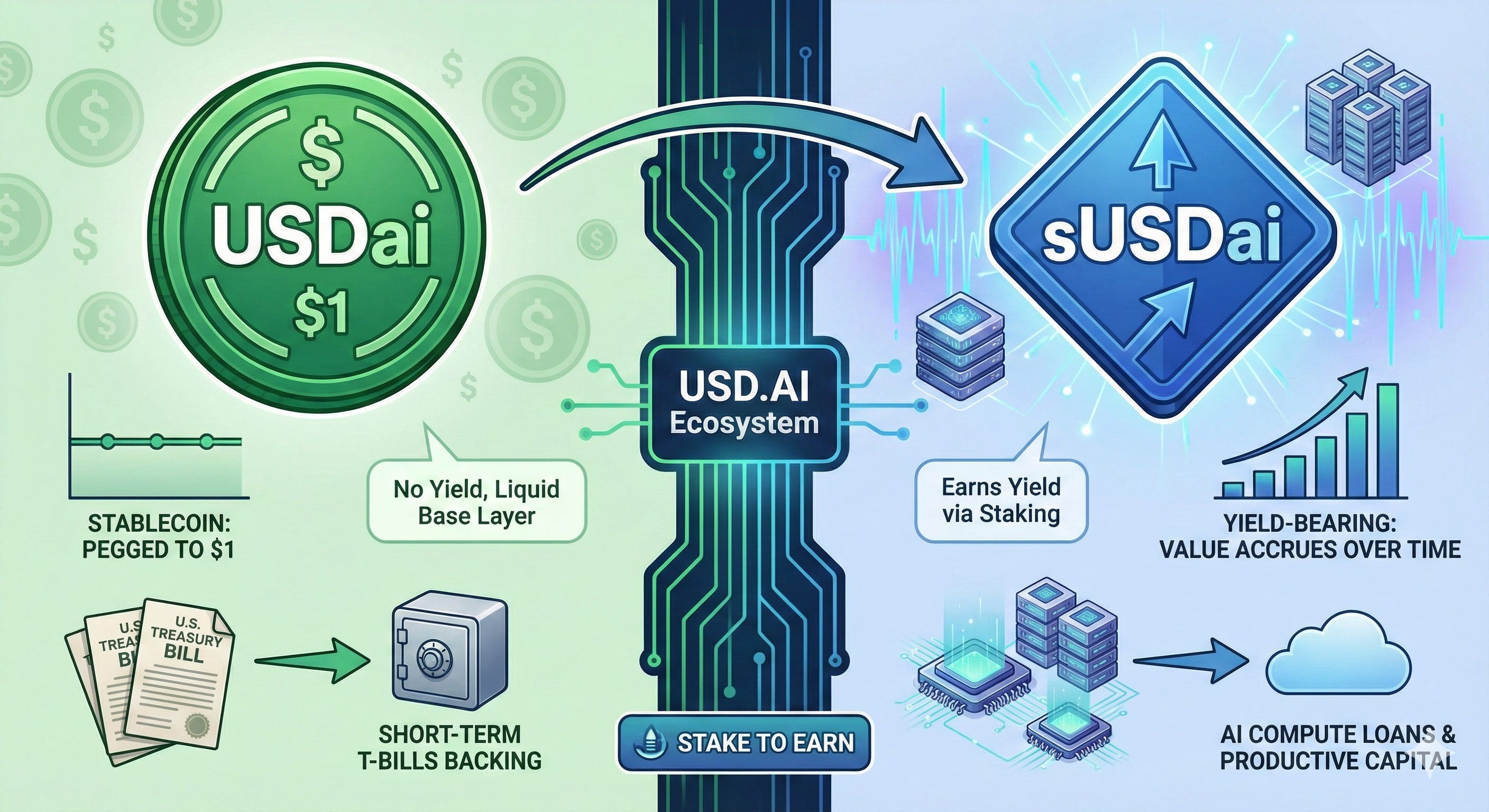
The launch centers on two related but different tokens:
🟢 USDai
A stablecoin, designed to stay close to $1.
Think of this as a synthetic digital dollar within the USD.AI ecosystem.
You don’t earn yield just by holding USDai.
USDai is the base layer — stable, liquid, and widely usable — but yield-free by design. (docs.usd.ai)
What backs USDai?
According to protocol details, funds backing USDai are often held in short-term U.S. Treasury instruments while the protocol prepares them for productive deployment. This helps avoid “cash drag” while capital waits to be allocated. (docs.usd.ai)
🔷 sUSDai
This is the yield-bearing version of USDai.
To earn anything, holders must convert USDai into sUSDai (typically by staking).
The value of sUSDai accrues yield over time, which is not paid directly as cash but reflected in the rising redemption value of each sUSDai.(IQ.wiki)
Where does the yield come from?
It comes from revenue-generating activities the protocol finances:
Loans backed by AI compute hardware
Productive uses of deployable capital beyond just cash investments
Interest paid back into the protocol that’s shared with sUSDai holders
The goal is to earn more than what short-term Treasurys would deliver, though returns are variable and not guaranteed. (CoinDesk)
🧠 3. So What Happens Under the Covers?
In simple terms: the protocol accepts stablecoin deposits → monetizes them through structured finance → and distributes a share of the economic return to sUSDai holders.
Behind the scenes the architecture has a few components:
Treasury management for idle funds
When capital isn’t actively deployed, it may be held in instruments like Treasury bills to avoid losing yield while waiting for productive use.(docs.usd.ai)Credit deployment to AI infra
Qualified operators can access liquidity using hardware as collateral. This segment is where the anticipated yield originates.(CoinDesk)
There are mechanisms (like legal asset tokenization and structured risk tranches) that try to align incentives and manage counterparty risk, but this is fundamentally a credit-linked system, not a traditional money market.
🗳️ 4. What Is $CHIP?
$CHIP is the governance token of the USD.AI DAO (Decentralized Autonomous Organization).(X (formerly Twitter))
Think of it as voting power and protocol influence:
Holders can vote on protocol parameters
They decide which initiatives the ecosystem supports
They influence risk frameworks and future expansions
$CHIP does not pay yield. It’s governance, not revenue-sharing.
📌 Why This Matters (And What to Watch)
This launch tells you a few things about the trajectory of new financial infrastructure:
Stablecoins are evolving
They’re no longer just digital dollars backed by cash or Treasurys; some are being tied to productive economic activity.Capital markets for AI infrastructure are emerging
Instead of banks or VCs exclusively underwriting GPU financing, crypto-native liquidity can flow into this layer.Returns are not guaranteed
Yield-bearing tokens like sUSDai accrue return over time, but that depends on how well the underlying financed assets perform. It behaves more like a credit investment than a savings account.Governance is decentralized
With $CHIP, USD.AI is pushing decision-making toward a tokenholders’ collective, rather than a centralized board.
🧾 In Plain Terms for Risk-Aware Readers
USDai is a digital dollar in this ecosystem — stable and used to participate.
sUSDai is the investment instrument — it’s meant to earn yield by backing productive real-world capital.
$CHIP is governance, not a payout token.
Funds flow through structured financial engineering, not traditional deposit/lending.
This is essentially a credit vehicle wrapped in digital assets, marketed with stablecoin terminology. It’s innovative, but it will attract scrutiny from traditional capital allocators as they evaluate risk, liquidity, and regulatory clarity.