
If you’re like me, you struggle to keep up with all the announcements around Generative AI, large language models, and the deluge of frameworks released every quarter by AI labs like Anthropic, OpenAI, and Google DeepMind.
Working with people who are building agents, part of my role is to help them navigate this constantly changing landscape while staying on schedule to release key features. My recent focus has been on understanding agent runtime platforms and how they work with popular frameworks like LangChain/LangGraph, CrewAI, and OpenAI Agents.
The Brain vs. Body Analogy
To a semi-technical audience, the best way to distinguish these is to think of them as the “Brain” vs. the “Body”:
The Frameworks (LangGraph, CrewAI, etc.) are the “Brain”
They define the logic, the personality, and the decision-making process.
Agent Runtimes (like AWS AgentCore) are the “Body”
They provide the physical infrastructure, the security, the memory, and the environment where that brain operates.
What Are Agent Runtimes?
One prominent example is Amazon Bedrock AgentCore, a collection of seven primitives (basic building blocks) for agentic applications. I’m most familiar with this platform, so I’ll use it as the reference model to help us understand the tech stack. The idea is: once we understand a single platform and framework ecosystem in depth, we can swap in other third-party, open-source, or managed offerings.
Key Difference: Agent Runtime vs. Framework
AgentCore (Runtime) is a managed runtime and control plane, not a coding framework. It runs agents in production with scaling, isolation, security, memory, and observability handled for you.
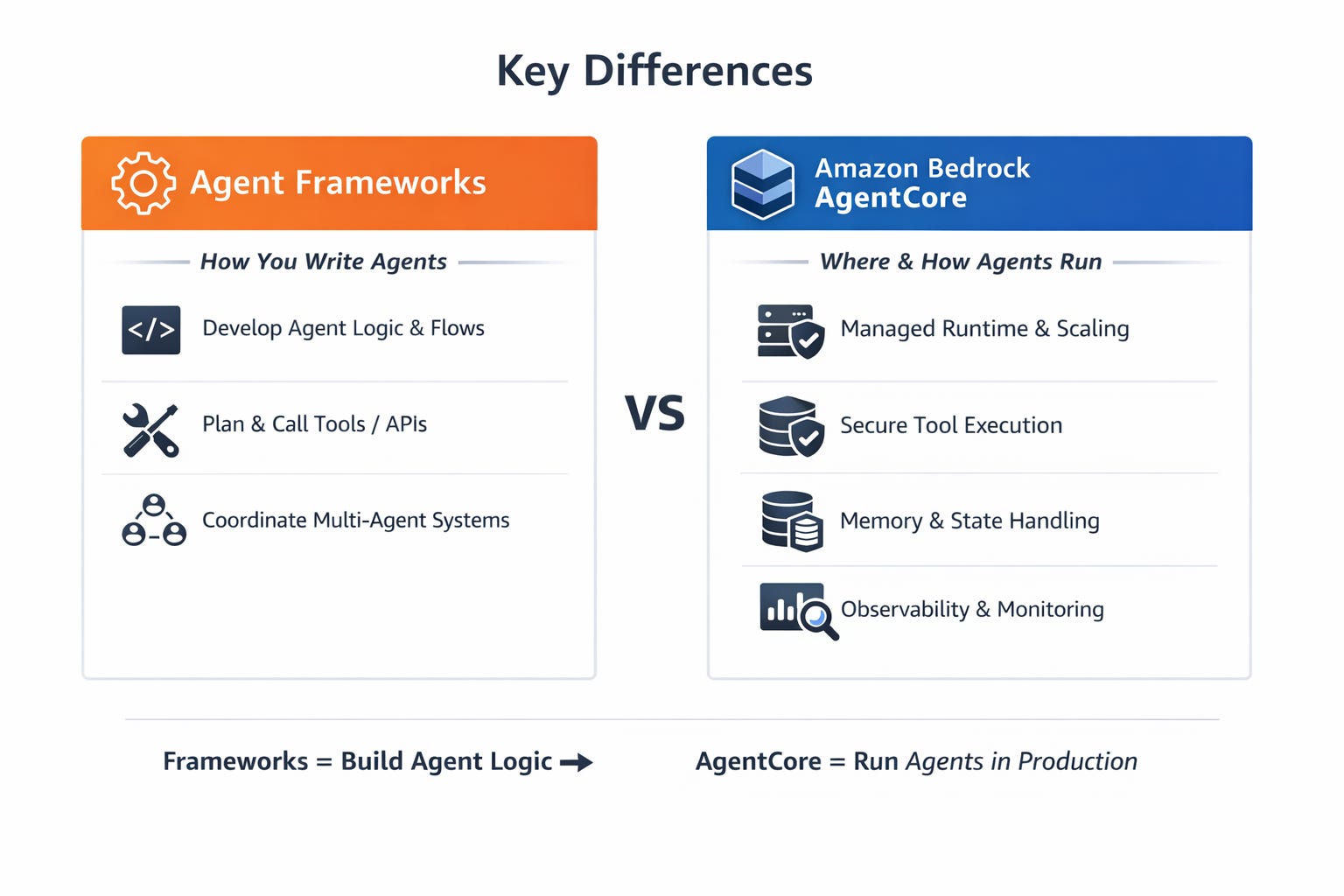
Frameworks (LangGraph, Strands Agents, etc.) are developer libraries that define:
Agent logic and loops
Planning and tool-calling patterns
Multi-agent coordination
In simple terms:
Frameworks = how you write agents
AgentCore = where and how agents run in production
How They Work Together
AgentCore hosts and operates agents built with frameworks:
You build logic in LangGraph, CrewAI, OpenAI Agents, or Strands Agents
You deploy them into AgentCore
AgentCore executes steps, manages state, enforces IAM, scales, and emits telemetry
Observability tools like Langfuse can be layered on top for deeper tracing and evaluation
Bottom Line
An agent runtime like AgentCore doesn’t replace frameworks—it makes it easier to productionalize and host the agents you’ve built at scale.
It’s important to note there are many runtime alternatives. I see many customers running their agentic applications on virtual machines and containers, but you can also look at hosted open-source or proprietary solutions. The key consideration when choosing your runtime is that it supports a broad range of agentic frameworks and observability options.
Top Runtime Options (January 2026)
Managed / Cloud Runtimes (Production-Ready)
AWS Bedrock AgentCore — AWS’s managed production runtime (framework-agnostic)
Google Vertex AI Agent Builder / ADK — Cloud-native agent runtime with integrated tooling & deployment
Microsoft Azure AI Foundry Agents — Enterprise agent service combining AutoGen + Semantic Kernel with identity & governance
OpenAI Assistants / Agent services — Managed agent hosting tied to OpenAI ecosystem
Open-Source / Developer Frameworks
These are libraries and frameworks you run yourself or embed in your apps:
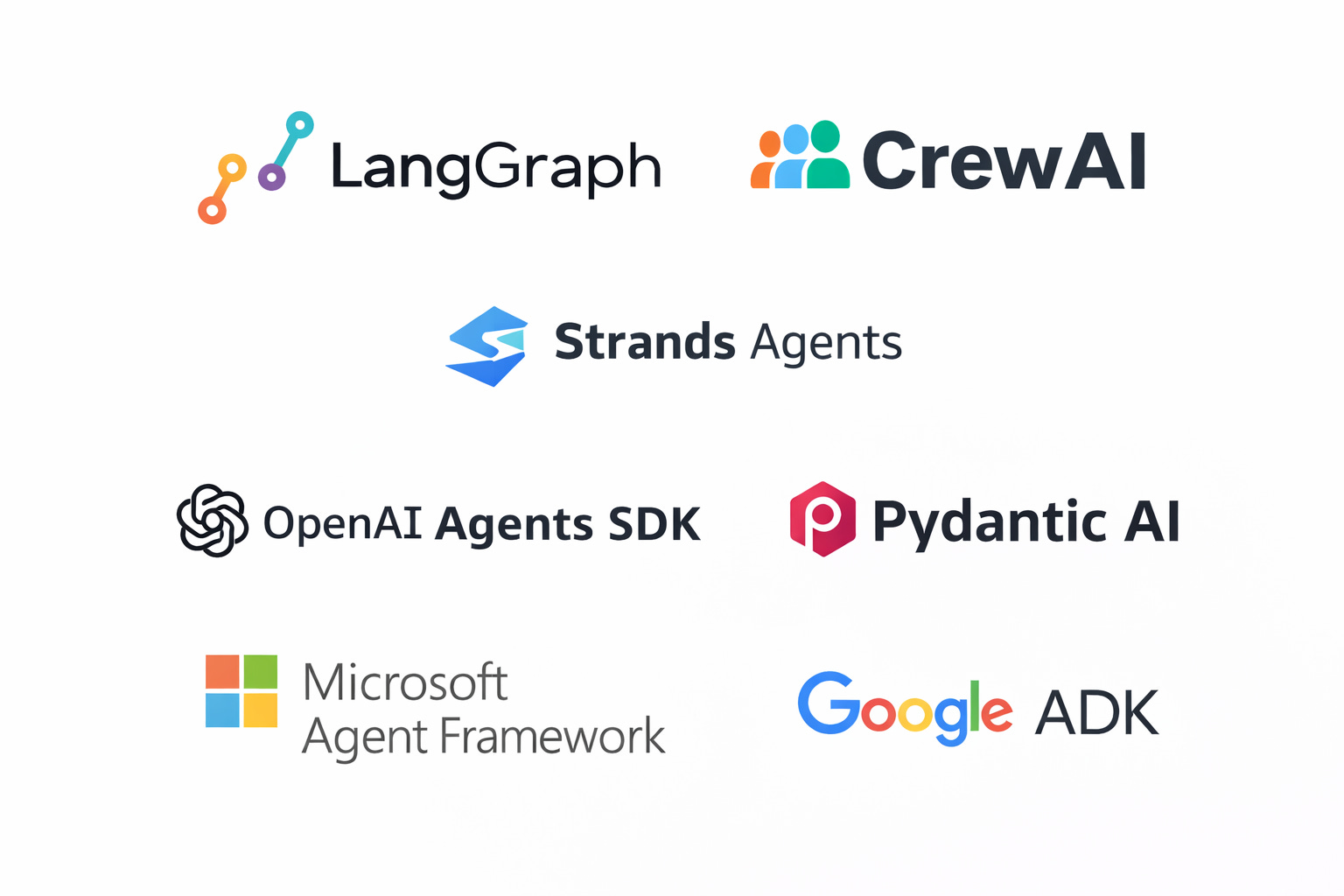
LangGraph — Leading open-source orchestration and workflow engine
OpenAI Agents SDK — Lightweight, model-agnostic agent framework
Microsoft AutoGen + Semantic Kernel — Multi-agent orchestration stack (often paired with Azure)
CrewAI — Role-based multi-agent coordination
Strands Agents (AWS open source) — AWS’s self-managed agent framework with strong AWS service integration
LangChain & related libraries — Broad ecosystem for agents, RAG, and workflows
*These thoughts and opinions are my own and not affiliated with any employer.
**Images created with ChatGPT.